
1
Identify the generation
Separate first-generation 12A cars from FC 13B cars and FD 13B applications before looking at replacement units.
The Mazda RX-7 and RX-8 are defined by a rotary powertrain rather than a conventional reciprocating piston layout. The RX-7 moved from the 12A to the 13B family, while the RX-8 used the dedicated 13B-MSP RENESIS.
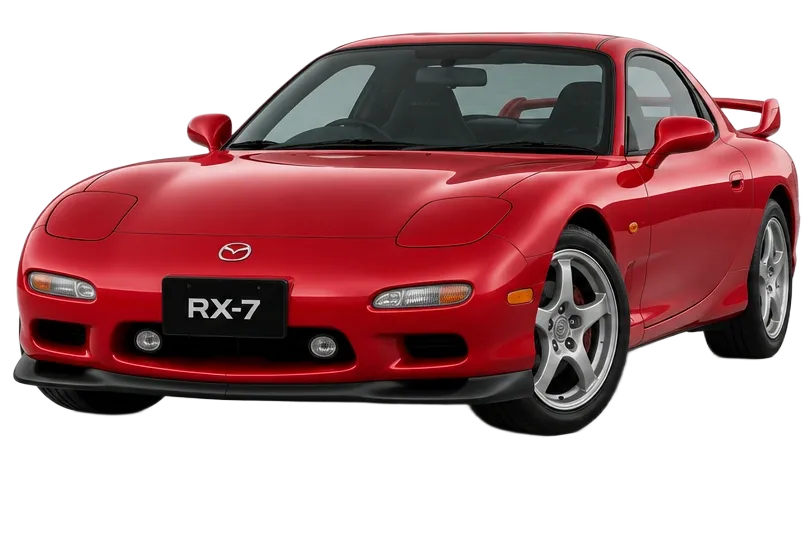
A Mazda RX-7 engine is not one fixed specification: Mazda used a 12A in the first-generation car, moved to the 13B in the second-generation FC, and used the 13B family in the third-generation FD, including the sequential twin-turbo application documented by Mazda. A 1995 Mazda RX-7 is part of this FD-era story and used a twin-turbocharged 13B. Mazda RX-7 12A engine for sale is therefore a different identification problem from an FC or FD replacement. Mazda RX-8 engine for sale belongs in the separate RX-8 application check because the later 13B-MSP RENESIS is not simply a generic 13B label.
The Mazda RX-7 engine range is easiest to identify by generation first, then by the exact rotary variant.
| Generation / application | Rotary engine | Identification point |
|---|---|---|
| First-generation Savanna RX-7 | Mazda RX-7 12A engine — two-rotor | Mazda documents the 1978 RX-7 with a 12A two-rotor rotary engine. |
| Mazda RX-7 FC engine — second generation | Mazda RX-7 13B engine — FC | Mazda documents the FC as being powered by the 13B rotary engine. |
| Third-generation RX-7 / FD | Mazda RX-7 FD engine — 13B family / 13B-REW turbo application | Mazda documents the FD with a 13B two-rotor engine and sequential twin turbocharging; Mazda also identifies 13B-REW in its technical material. |
The Mazda rotary engine 13B is a two-rotor Wankel design in which a triangular-shaped rotor turns inside a shaped housing to carry the intake, compression, combustion and exhaust processes. Mazda describes the rotary's compact construction as technically distinct from a reciprocating engine, and its technical review identifies the eccentric shaft, rotor, rotor housing and sealing system as core elements. Mazda 13B rotary engine for sale should therefore be treated as a transactional search that still needs the correct donor/application details. For the broader commercial rotary query, Mazda rotary engine for sale is not, by itself, enough information to prove that two rotary units are interchangeable.
Apex-seal condition is a legitimate mechanical consideration because the sealing elements sit at the interface between the rotor and the housing. Mazda's technical literature specifically models apex-seal motion and load, while its rotary-engine material treats the seal system as part of the engine's core gas-sealing arrangement. That explains why apex seals feature so prominently in rotary ownership discussions, but it is not evidence of a universal failure rate or a reason to label every 13B unreliable.
Mazda rotary engine 13B comparison showing rotor housing, eccentric shaft and apex-seal architecture
The Mazda RX-8 engine is the 13B-MSP RENESIS, a two-rotor, water-cooled rotary developed specifically for the RX-8. Mazda gives RENESIS a total displacement of 654cc × 2 and describes its side-intake and side-exhaust layout as a key part of the new-generation design. The RX-8 therefore continues Mazda's 13B rotary lineage without being the same specification as an RX-7 13B-REW. For a buyer or owner, the useful distinction is the exact engine code and application, not simply the shared 13B family name. Mazda RX-7 rotary engine for sale is the relevant commercial route for an RX-7 application, while Mazda RX-8 engine UK is the appropriate destination when the vehicle is an RX-8.
Start with the vehicle generation and chassis/application, then confirm the rotary family and the exact engine variant. This matters because the same broad 13B family name covers different applications, and turbocharged FD material is not interchangeable with an RX-8 RENESIS identification.
Separate first-generation 12A cars from FC 13B cars and FD 13B applications before looking at replacement units.
Use the vehicle documentation, engine identification and application details to establish whether the unit is a 12A, 13B-family or specific 13B variant.
For an FD, confirm the turbocharged application and the relevant 13B-REW identification rather than stopping at the word 13B.
Use the registration or VIN alongside the engine identification when checking a replacement requirement, then confirm the application with the seller or workshop before purchase.
Commercial questions such as Mazda RX-7 engine price should come after that identification step. The same principle applies when the search is for an RX-8 rather than an RX-7: RX-8 engine must be matched to the correct RENESIS application.
Replacement and rebuild are different decisions. A replacement is primarily an application-matching exercise: establish the generation, engine family, exact variant and vehicle identity, then compare the available unit against those requirements. A rebuild is a condition and machining decision that depends on the state of the rotor, housings, bearings and seals; this page does not set a universal rebuild threshold or workshop price.
The important point is that a 12A, FC 13B, FD 13B-REW and RX-8 13B-MSP can all sit under the broad description of a Mazda rotary engine while remaining different technical applications. That is why a request framed only as '13B engine' can be too broad for safe matching.
Engine Finders helps you find replacement engines and other replacement parts for your vehicle, including gearboxes. Engine Finders can also help you find a repair workshop or garage near you. Enter your vehicle registration number to look up your vehicle's details.
To Find The Best Supplier Near You